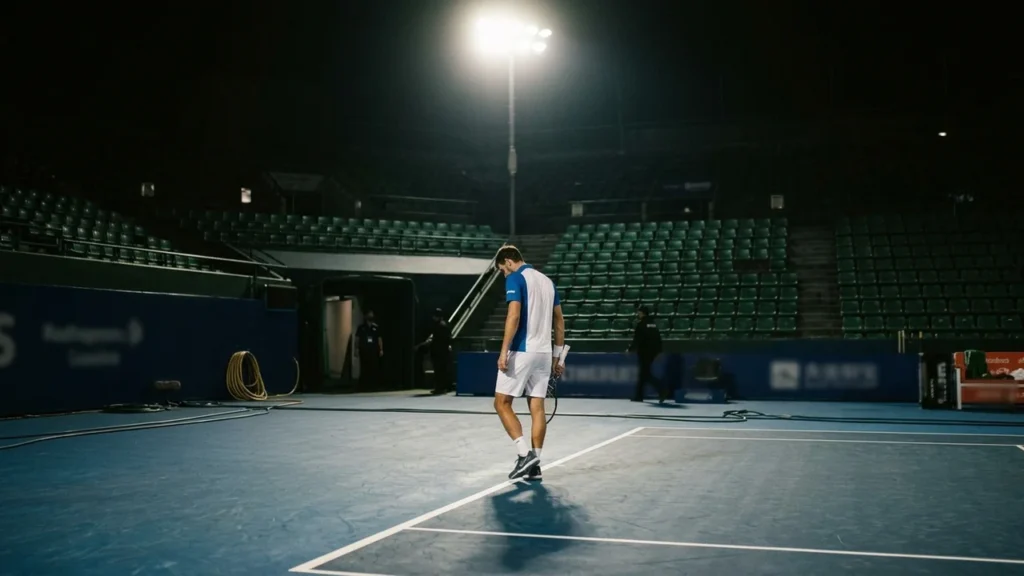
Novak Djokovic sat slumped on his chair, head in hands, as the Arthur Ashe Stadium crowd watched the match slip away. At 1-3 in the fifth set, the four-time US Open champion was in tears, physically depleted and emotionally raw. For the first time in two decades, he had lost in the first round of a Grand Slam, beaten by Argentina’s Mariano Navone 7-6(5), 5-7, 4-6, 6-2, 6-1 after four hours and forty minutes.
Early on, the match followed a familiar Djokovic script. He absorbed Navone’s aggression, moving from deep court positions into his familiar baseline press. The Serb manipulated the court with angled returns that shifted Navone wide before he attacked the open space. Djokovic led by a break in the fourth, a position from which he has historically suffocated opponents with relentless depth and minimal error.
That control did not last. Djokovic’s pressing system, dependent on anticipation and physical reserves, began to break down as the match wore on. The Argentinian, ranked No. 49, turned the pressure around, dictating with heavier, deeper balls that pinned Djokovic behind the baseline. Navone targeted Djokovic’s forehand wing, drawing him into longer exchanges and forcing the veteran to create his own pace.
Djokovic committed 70 unforced errors, including 29 in the final two sets. Navone won 63.3 percent of points across those sets. By hitting behind Djokovic, he disrupted the Serb’s lateral recovery and turned a reactive performance into an attack.
Djokovic’s Physical Unraveling and Navone’s Tactical Shift

Djokovic’s body showed signs of trouble early, but the breakdown accelerated in the fourth set. Before the decider, he called a medical timeout and sat motionless while the physio worked on his back. Courtside, he vomited, wiped his face, and continued. His movement dulled, his lateral bursts slowed, and the precise footwork behind his counter-punching game fell apart.
Navone recognized the opening and stopped playing to Djokovic’s strengths. Rather than feeding crosscourt exchanges that allowed the Serb to defend, he injected pace down the middle before using surprise angles to pull Djokovic off balance. From 2-2 in the fourth, Navone won ten of the next eleven games. Djokovic was still competing, but his body no longer allowed him to dictate the terms.
After the match, Djokovic admitted the problem extended beyond this night. “It’s something that I’ve been carrying, unfortunately, pretty much every match this year. Vomiting, throwing up, a serious issue there. Then my whole body starts to collapse, basically cramping and pain. The back just gave up in the end and shoulder, and I couldn’t close it out.” He described a season-long pattern that has eroded his ability to execute the defensive and offensive patterns that defined his era of dominance.
The defeat ended Djokovic’s streak of 78 consecutive opening-round Slam wins, the longest such run in the Open era. He had never before lost prior to the third round at the US Open, and not since 2006 had he exited a major this early.
Physical issues first obvious in Rome and Cincinnati earlier this season have now put his quest for a 25th major title on indefinite hold. Navone advances to face either Matteo Berrettini or Stan Wawrinka.