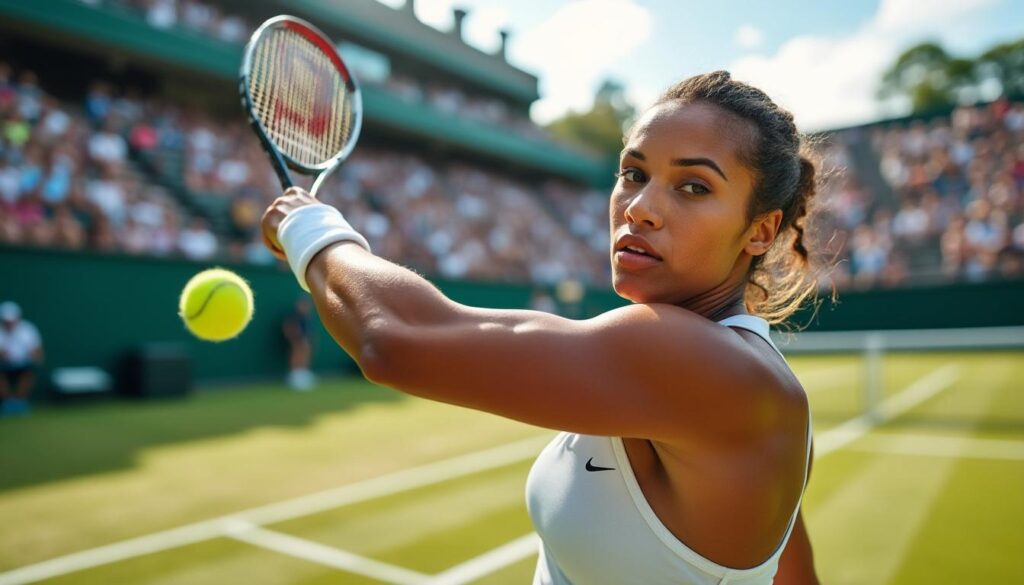
Backhands stand as a pillar in tennis, the cornerstone of numerous pivotal points in matches, separating the amateurs from the pros. Their allure lies not just in brute power, but in the rhythmic precision and strategic placement that can dismantle opponents’ defenses. As 2025 unfolds, the evolution of backhand mastery now hinges heavily on the intricate dance of footwork patterns, refining contact heights for optimal swing efficiency, and pinpointing targets with surgical accuracy. The subtlety of these elements doesn’t just elevate a player’s consistency; it revolutionizes the entire approach to backhand play.
Imagine a tennis court where every backhand stroke is a calculated symphony of balance, speed, and smart targeting — this is the new era heralded by insights into footwork dynamics and precision contact. Whether a budding novice thrilled by the sport’s drama or an avid follower hungry for expert tips, understanding these facets empowers one to transform shaky swings into quelled storms. The secret formula lies in the fusion of relentless practice with modern tactical intelligence, showcased abundantly across recent tournaments and echoed by top coaches’ drills.
From legendary clashes in indoor arenas to the fierce rallies in grass-court battles, the key differentiator has been the players’ ability to sustain a backhand pro level of performance, aided by dynamic footwork and a target tracker mindset. These components dictate not only consistency but also the agility to adapt and dominate through extended rallies. Insights from high-stakes matches at events like the Paris Masters and strategic perspectives from doubles specialists offer invaluable lessons on integrating these skills.
It’s this compelling union of technique and tactical knowledge that defines what it means to possess a consistent swing in today’s competitive landscape. The mastery over where and how to meet the ball—contact height mastery—combined with fluid footwork flow shapes champions and garners roaring crowds. The ensuing exploration delves into the heart of these facets, providing a granular view tailored to inspire and educate all tennis enthusiasts.
Key Takeaways:
- Footwork Patterns: Efficient movement is fundamental to consistent backhand strokes, minimizing unnecessary steps and optimizing strike timing.
- Contact Height Mastery: Hitting the ball at the correct vertical plane governs control and power balance.
- Target Precision: Strategically choosing and hitting targets disrupts opponent positioning and maximizes shot effectiveness.
- Consistent Swing Techniques: Blending rhythm and mechanics fosters reliability under pressure.
- Strategic Pattern Play: Anticipating shot placements and footwork to gain the upper hand in rallies.
Sommaire
ToggleRefining Footwork Dynamics for Superior Backhand Accuracy
Footwork serves as the unsung hero behind every consistent backhand, orchestrating an elegant prelude to the strike itself. Players who master footwork flow unleash a backhand pro presence on the court, aligning their body to generate seamless power and control. The foundation rests on three main movement phases: the split step, the step out, and the recovery. Efficient transitions between these phases reduce the lag between response and shot execution.
In competitive settings, minimizing unnecessary lateral steps during pattern play drastically improves timing and swing smart strategies. For example, top-level players reduce their footwork to a split step followed by a decisive sidestep toward the ball’s trajectory, rather than a scramble of multiple small adjustments. This economy of movement enhances the ability to meet the ball squarely, a critical factor for consistent swing power and precision contact. When playing indoors, as seen in the Moselle Open conditioning drills, footwork dynamics adapt intelligently to faster surfaces demanding quicker reaction times and refined placement.
- Split step prepares the body and triggers readiness.
- Step out directs the player toward the ball for optimal stance.
- Recovery ensures balance and swift repositioning for subsequent shots.
- Maintaining low center of gravity sustains stability and reduces errors.
The impact of such footwork refinement becomes apparent when studying prodigies like Gauff, whose coach eloquently emphasizes the importance of anchored foot placement before executing her backhand shot. This approach not only contributes to power but also reduces the risk of mishits by stabilizing the contact point through controlled motion. Valuable video analysis and drills from the November tactical doubles session illustrate how these patterns can be drilled regularly to ingrain muscle memory.
| Footwork Phase | Purpose | Effect on Backhand Consistency |
|---|---|---|
| Split Step | Ready stance and alertness | Enhances reaction speed and prepared positioning |
| Step Out | Moves player toward the anticipated ball location | Ensures optimal stance for swing accuracy |
| Recovery | Resets balance for next move | Maintains court coverage and readiness |
This precise coordination of footwork with the swing path allows for consistent shot placement and sets the stage for mastering the next critical element—contact height.
Understanding and Mastering Contact Height on the Backhand
Contact height is often overlooked yet it plays a decisive role in maintaining a consistent swing and controlling shot outcomes. The vertical trajectory at which the racket contacts the ball influences both the shot’s depth and spin potential. Professional players carefully adjust their contact height depending on the incoming ball’s pace and angle to maximize precision contact and minimize errors.
Modern coaching techniques stress the importance of hitting the ball slightly in front of the body but at a height tailored to the shot’s intent. For deeper, penetrating backhands, a contact point closer to waist or slightly higher provides the necessary leverage for powerful drives. Conversely, when executing slices or drop shots, a lower contact height is preferred to impart the desired effect. Insightful breakdowns from recent matches have shown how players like Jannik Sinner optimize backhand depth through precise height adjustments, emphasizing control over brute force, as explored in analysis articles such as Backhand Depth Techniques.
- High contact for topspin and aggressive baseline shots.
- Mid-level contact for controlled, stable responses.
- Low contact for slices and deceptive shots.
- Constant adjustment based on ball trajectory, court surface, and opponent positioning.
Achieving the ideal contact height demands a combination of body mechanics, core strength, and precise timing. This is why specialized training regimes focusing on core stability and backhand strength, highlighted in resources like Tennis Strength and Mobility, have become integral to professional player development in 2025. With consistent practice, players develop an intuitive sense of contact height, leading to faster shot preparation and improved shot quality.
| Contact Height | Typical Usage | Effect on Shot |
|---|---|---|
| High | Topspin baseline shots | Generates depth and aggressive spin |
| Mid | Flat, controlled strokes | Enhances reliability and precision |
| Low | Slices, drop shots | Creates deception and variety |
Targeting awareness complements contact height mastery, as it allows players to direct strokes consciously rather than relying on reaction alone. The synergy between these two elements leads to a consistent backhand capable of disrupting opponents’ rhythm.
Target Tracker Strategies for Pinpoint Backhand Placement
The capacity to pick and hit tactical targets on the opponent’s court separates merely good backhand strokes from dominant ones. Effective target tracking involves selecting zones that exploit opponent weaknesses, open spaces, and court geometry. This “target precision” demands acute court awareness, anticipation, and swift footwork adjustments, all embedded within the concept of swing smart gameplay.
Professional match analysis reveals patterns where successful players consistently redirect backhand shots to corners or feed their opponents deep to provoke errors. A realistic example comes from the Moselle Open’s strategic points, where winners employed a relentless focus on hitting forehand sideline targets off backhand setups, forcing defensive retreats. Coaches today emphasize building a ‘mental target tracker’ through drills that simulate varying court scenarios, helping players internalize spatial dimensions.
- Identify opponent’s weaker wing through observation.
- Use angles to open the court and create opportunities.
- Alternate shot depth to keep the opponent guessing.
- Integrate footwork flow to maintain position for target hits.
Players benefit immensely from combining target tracker precision with pattern play that anticipates opponents’ responses, a skill underscored in doubles tactical lessons such as those shared at the November tactical doubles session. This holistic approach encourages players to move smarter, anticipate better, and strike with unerring accuracy.
| Target Area | Purpose | Strategic Outcome |
|---|---|---|
| Crosscourt corner | Creates sharp angles | Forces opponent out wide |
| Down the line | Surprise element | Breaks opponent’s rhythm |
| Deep to baseline | Pushes back opponent | Limits their offensive options |
Mastering target precision coupled with fluid footwork enhances a player’s ability to sustain long rallies and dictate play tempo, vital qualities for competitive success in 2025’s demanding tennis tournaments.
Combining Consistent Swing Mechanics with Backhand Strategies
Backhand consistency transcends the swing itself; it is born from integrating swing mechanics with footwork dynamics, ideal contact height, and sharp targeting ability. The consistent swing is rhythmical, compact, and allows adaptation to a variety of rally situations without compromising power or accuracy. This balance requires players to fine-tune their grip, racquet head speed, and follow-through patterns.
Innovative training regimens emphasize the “chucking” action rather than an outright snap of the wrists, a subtle technique to maintain control and reduce mishits. This method is notably beneficial during extended backhand loops, where maintaining momentum and contact precision is essential for winning points. Elsewhere, a focus on ‘swing smart’ methods involves analyzing opponent tendencies and modifying backhand responses to exploit these insights, a tactic championed by many top competitors in the Miami matches and beyond.
- Compact swing reduces errors under pressure.
- Racquet head control improves shot placement and spin.
- Follow-through mechanics add consistency and speed control.
- Grip adjustments tilt shot trajectories strategically.
Data from advanced tennis sensor technologies in 2025 now provides players with detailed feedback on swing and footwork patterns, empowering them to refine every nuance of their backhand stroke. This feedback loop undoubtedly fast-tracks the journey from amateur execution to backhand pro caliber precision, demonstrating the future of tennis training.
| Element | Benefit | Impact on Consistency |
|---|---|---|
| Compact Swing | Reduces energy waste | Enhances shot reliability |
| Racquet Head Speed | Increases ball spin and control | Improves depth and accuracy |
| Follow-through | Stabilizes shot dynamics | Enables consistency under fatigue |
The evolution of footwork dynamics paired with smart swing mechanics continues to shape the success stories in tennis, mirrored by champion performances in diverse conditions and tournaments worldwide such as the recent WTA indoor events.
Building a Personalized Strategy with Pattern Play and Footwork Flow
Long-term backhand consistency arises from not only mastering isolated skills but also blending them into a fluid style of play characterized by intuitive pattern play. Pattern play involves rehearsing sequences of shots and footwork that mimic real-match conditions, allowing the player to anticipate and react instinctively.
Footwork flow, the smooth continuity of movement across various shot patterns, ensures that players remain balanced and ready amidst changing rally demands. This cohesion results in shorter reaction times and more precise control over ball placement, essential for sustaining a high level of performance during rallies that last 10 or more shots—a common occurrence in modern tennis circuits.
- Identifying common shot sequences to train footwork response.
- Integrating target precision into shot patterns.
- Practicing recovery steps to maintain optimal positioning.
- Adapting patterns based on opponent play styles and court surface.
Training with a focus on these elements was spotlighted recently at the Japan Open, where players reported significant improvement in rally control and backhand consistency after regimented pattern play drills. Availability of tennis gadgets and sensor analytics further amplify the gains by providing measurable indicators on footwork efficiency and swing precision, creating a feedback-rich environment for players at every level.
| Pattern Element | Purpose | Benefit |
|---|---|---|
| Shot Sequence Repetition | Develops muscle memory | Improves automatic response |
| Footwork Integration | Sustains balance and pace | Reduces errors in motion |
| Target Precision | Teaches strategic placement | Disrupts opponent’s rhythm |
As tennis advances into 2025 and beyond, embracing such a synergy of technique will be pivotal for players looking to ascend to the ranks of consistent backhand performers. The fusion of footwork patterns, contact timing, and targeted shot placement unlocks the door to true backhand mastery.
What is the ideal footwork pattern for a consistent backhand?
The most effective pattern involves a quick split step followed by a step out toward the ball, maintaining a low center of gravity and balanced recovery to prepare for the next shot.
How does contact height affect backhand performance?
Contact height determines the balance between power and control; hitting higher favors topspin and depth, while lower contact is suited for slices and deceptive shots.
What role does target precision play in backhand success?
Accurate targeting disrupts opponents by exploiting court angles and weaknesses, increasing pressure and opening up court space for winning points.
How can pattern play improve backhand consistency?
Pattern play builds muscle memory for custom shot sequences, enabling players to anticipate opponents’ moves and maintain steady footwork flow during rallies.
What training tools enhance backhand consistency in 2025?
Modern tennis sensor technology and strategic tactical sessions provide players with data-driven insights on swing mechanics and footwork, accelerating improvement.